Please Note: For a quick overview, please refer to The Hands of the Dancer, Can Video Hold Physical Properties, and Fear of Flight.


SELECTED WORK


Videomusic


The Hands of the Dancer (21:49 – 2008, Videomusic)

Relevant Excerpts: 3:19 – 6:40, 13:00 – 17:00.

The Hands of the Dancer is a 21 minute HD sound and video piece that focuses on imagery related to the mythology of temple dancers and to dreaming. A man sleeps and dreams of a dancing girl who multiplies and shimmers like the desert. Her image is continuously mutating and becomes the landscape of the dream. She looks into a mirror and appears next counting peacock feathers while another presence takes her place as the dancer, making contact with the dreamer.

This video explores the multiple ways that movement and form can be abstracted through surface and temporal manipulation. The narrative evokes a dreamscape in which characters exchange identity and develop through physical transformation. The sounds and images depicted are inspired by traditional baladi form and are meant to evoke a state in which these bodily gestures convey secret meanings that need not resort to language. The Hands of the Dancer was created by Freida Abtan with footage of Andrea Fryett, Olivia Li, and David Drury.

Freida’s sound work descends from formal electroacoustic composition strategies and from the great body of experimental electronic music that concentrates on the exploration of the spectral properties of sound. She primarily works with samples of both musical and non-musical objects that she records herself and then manipulates, often beyond recognition, through techniques derived from musique concrete and through successive layers of digital signal processing. Freida uses structures reminiscent of popular music and more abstract compositional variants to sequence these sounds into melodic songs before incorporating her own treated voice.


Reactive Video Software for Installation


Can Video Hold Physical Properties?

Fire – Erik Conrad and Freida Abtan (2006 – Responsive Video and Sound, MaxMSP Jitter)
Weight (2005 – Responsive Video, MaxMSP Jitter)
Melt (2005 – Responsive Video, MaxMSP Jitter)


Multimedia Production


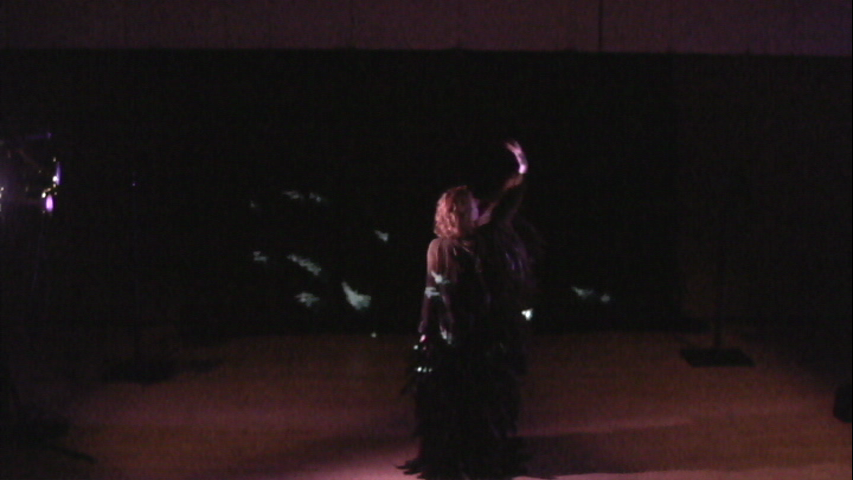
Fear of Flight (35:00 – IN PROGRESS, for electroacoustic music, aerial performer, real-time video capture system, electronically-enhanced costumes, and surround video)

A small excerpt from a ‘test’ performance.

Two excerpts from Flock of Birds, a 33:00 min videomusic work created as a study to develop Fear of Flight ’s visual processing techniques.

Fear of Flight will investigate the intersection of surround audiovisual composition and live performance in order to draw meaningful conclusions about the experience of presence and the role of the performer, within immersive1 media composition. The production will integrate abstract audiovisual narrative with a live dancer’s floor and aerial performance. It will also consider the sensory experience of the audience, who must adapt to their own physical situation in the surround projection environment. Motion-tracking technology and live video capture will be employed to synchronize aspects of the dancer’s movement in the air with the audiovisual composition during the performance. Part of the aesthetic and technical challenge of this piece will be to seamlessly integrate high-resolution, pre-rendered, audiovisual material with audiovisual material that is generated dynamically within the performance situation.

Fear of Flight divides into four movements, based on an abstract narrative of spiritual desire and physical transformation evolves, phrased in the metaphorical language of birds and space travel. A woman dreams of birds, and transforms herself into a bird-woman, to join them. Her own metamorphosis complete, she discovers that she is trapped in a cage and cannot fly freely as in her fantasies. After a difficult ordeal, in which she re-examines the nature of her own desire, the woman transforms her surrounding cage into a spaceship, and enters a new world from within it.

The first movement of Fear of Flight, “the things we long for”, introduces the work’s thematic concerns of desire and the sacred power of the unseen. A woman’s dream of birds, stirs a longing within her to take flight. She examines an empty birdcage and hears the movements of an invisible flock of birds surrounding her, commanding her attention.

In the second movement, “the borders of the spirit”, the woman is inspired by her dream, and her own world transforms to resemble its features. The new landscape that surrounds her is filled with magical creatures, half-women, half-bird. She tries to join the bird-women, but they reject her. Eventually, the woman dons a clock of feathers and is allowed to join the flock. She flies towards a perch in the air. From her new vantage point, she sees that she is now trapped in the birdcage she once considered.

The woman confronts her situation in the third movement, “gravitational pull.” A hybrid landscape, formed of both the natural world and her dreams, surrounds her. The woman recognizes her own form in a procession of creatures, and has a sudden insight into her situation. She merges with her dream identity, and expels tendrils. The tendrils dissolve into a flock of birds that transform her cage into a space ship. Though the woman recognizes bits of her own fantasies through the windows of the ship, she seats herself calmly and prepares herself for space travel. The ship takes off in a dramatic explosion.

After a terrifying journey, the fourth movement, “in outerspace we trust,” begins. The woman floats weightless, in the charred husk of the spaceship. The walls unfold to reveal a new world composed of stars and bird-creatures, in which the woman performs. Her movements give shape to both the matter and physical processes that surround her.

Stills from Flight of Birds (the visual study for Fear of Flight)


Costume Images


Bird Woman (12:00 – 2009, for Electroacoustic Music, Solo Dancer, Costume, and Video)

Relevant excerpt: 2:47 – 6:10.

Bird Woman is a ten minute multi-media dance piece written and directed by Freida Abtan. The piece incorporates electronic music, lavish costume, video projections, and an original choreography created and performed by Meg Weeks.

Thematically, Bird Woman draws on notions of anima and of spiritual transformation. The narrative of Bird Woman expands upon, and is inspired by traditional Yoruban mythology in which a woman’s spirit may leave her body to travel outside in the form of a bird. The piece is divided into four movements that evoke a narrative in which a woman longs for flight, discovers a bird costume and ritually transforms herself with it so that she can fly. In landing, the woman becomes aware of her new state through her unfamiliar shadows, within which she sees the flapping wings of birds. She discards the costume but leaves on the mask, symbolic of her transformed spirit.

The four movements of Bird Woman unfold in sections as follows:

Movement 1
i) the dream of flight
ii) enrobement

The dancer begins her performance on the ground and slowly lifts her body upwards from the floor, accompanied by sounds suggesting beating wings. Though her movements are tied to notions of flight and the physical forms of birds, her body reflects the weight of a human woman. Twice, a group of birds are projected flying overhead and each time the dancer acknowledges their path with her body: first, by striking a pose in a contrasting direction, and second, by tracing the birds’ movement with her hand. Eventually the dancer becomes aware of a gleaming black cloak of feathers affixed to a pole near the back curtain of the stage area. After putting on the cloak, she discovers a mask in the form of a bird’s head and carries it towards center stage.

Movement 2
iii) the procession
iv) greeting the moon
v) the procession part 2

The dancer holds the bird’s mask, extended so as to appear to be in the same place as her head. Ritually, she turns from one side to the other, extending and contracting the mask from her body, offering it to the cardinal directions. The dancer places the mask on top of her head as if to affix it there and then extends it back in front of herself as she again turns forward. Video projections fade from black against her body, in which two versions of herself, wrapped in cloaks of feathers and masking flickering black and white shapes, emerge. The images of the two attendants grow larger on either side of herself as if they are approaching forwards. A bell rings and the dancer places the mask back upon its stand.

The video image projected against the back curtain is replaced with one of a glowing and revolving moon. The dancer moves in front of the moon and blocks its projected light with her body so that her shadow is discernible against the bright light of the moon’s form. She flaps and settles her arms in front of it, like wings. A bell rings and she falls to the floor in the form of a prostration. Within the projected image, in front of the moon, the dancer’s image is displayed carrying the bird’s mask as before. The projected image of the dancer extends and contracts the mask in the same sequence as the live dancer did previously. After offering the mask to the cardinal directions, placing the mask upon her head and turning forwards, the projected image of the dancer fades out against the moon, and is replaced with a wave of black bird shapes that fly upwards slowly in a single gesture. The dancer rises from the floor and follows the movement of the birds with her arms. The moon fades to black.

Movement 3
vi) flight

In this section of the piece, the dancer performs a choreography referencing the notion of flight that incorporates the weight and motion of the cape she is wearing. The audio from the first movement of the piece is recapitulated and expanded on with more frenetic sounds and more distinct, active, aural gestures. Video projections of multiple layers of birds flapping their wings flood the stage area, breaking against the dancer’s body in a brighter light than that which illuminates the rest of the stage. These projections are the footage previously seen flickering inside the attendant bodies of movement 2. The projection of flapping birds’ wings fades and is replaced with a white and black division of the projection surface. This line of light is used to portray perspective. The background behind the dancer lifts and tilts to the right as the dancer mimes her flight.

As in the first movement, twice a group of birds are projected flying overhead and each time the dancer acknowledges their path with her own body. The first time this happens, she acknowledges them with an arm gesture as she did previously in the first movement, the second time, the projection of the birds is stopped from hitting the background by the cloak of feathers as the dancer moves between the projection and the back curtain of the stage. As the dancer interrupts the projected video, the white birds appear to be captured upon her form.

As the frenetic music begins to slow, the dancer’s movements grow more sinuous and thoughtful. She removes her cloak and approaches the back curtain, wrapping the cloak around herself as a skirt or holding it behind herself while she walks.

Movement 4
vii) casting shadows
viii) bird woman

The dancer walks back and forth across the back curtain of the stage. Projected against the curtain are multiple forms of her own body engaged in similar movements to her own. These forms occasionally disappear and re-appear, start and stop. They mask flashing white and black light, now recognizable as flapping birds’ wings after being featured discernibly in movement 3. As the multiple projected forms of the dancer fade out of existence, the dancer moves towards the bird mask, resting on its stand against the back curtain. She leaves the cape on the ground behind her and puts on the mask. Wearing it, she walks towards center stage and moves her arms as if they were wings. Slowly, she settles herself on the ground as the music fades and the house lights dim around her.

Stills from the Documentation


Costume Images


Electronics Design

s_platters: spinning platters (2010, lazy susans, shelving, custom electronics and software system, MaxMSP)

s_platters is a controller for electronic audio production, created by Freida Abtan at Brown University. The system uses magnets, hall sensors, gyroscopes, and capacitance sensors to track the momentum, position and manipulation of three spinning platters. Inertia and friction are naturally incorporated into these values. Each platter smooths and conditions its own data before sending it via a wireless network to custom software for statistical processing. Software audio instruments use the generated values to make music.

The construction of the controller encourages multiple kinds of human gestures, such as gentle lateral pushes towards a platter’s rotational spin, or resistance force applied from above. The long smooth rotations of the platters, arise as much through their natural physics as from significant human effort. Effort is used when making small changes to platter motion, or when opposing the physical forces acting on the platters. Variations in the speed and direction of platter manipulation are points of control for the instrument’s musical output, as is touch, or close proximity.

The controller is capable of endless mappings to software instruments. In performance, it is commonly used for polyphonic playback of at least two, and often three, voices. One voice can be controlled by a single platter’s movements or it can respond to the manipulations of several. Further, correlated gestures between platters have an excitation effect on the software system. The gestures with which the platters are manipulated, control both the textural quality of sounds produced as well as their dynamic shape. Several software instruments can be combined into an open composition, in order to keep things varied during a live performance. Some software instruments already developed for s_platters include: granulation process according to a combination of momentum and rotation, granulation overlap process according to rotation, scrub sample playback according to momentum and rotation, re-sampling, banks of filters and delays according to touch and/or rotation, FM synthesis according to touch timing and rate of rotational change, and pattern creation based on rotation and touch.

Images of the controller


Screenshots of the Performance System


Electroacoustic Composition


Mistah Kurtz (2008 – 5:53)

Relevant Excerpt: 1:55 – 3:00


The Act of Repetition (2006 – 7:37)

Relevant Excerpt: 0 – 2:00


even small things break (into smaller things) (2004 – 5:28)

Relevant Excerpt: 0 – 2:10